


|
|
|
|
Peru – The North |
|||
 |
A journey north is a journey back in time – to the ancient Moches and their Lord of Sipan, the "King Tutankhamun of the Americas," considered to be the most important tomb in the western hemisphere, to the ruins of Chan Chan, and the Valley of the Pyramids. Wherever you travel with your kids in this part of Peru, you'll encounter remnants of ancient traditions that continue to this day. |
 |
Chan Chan – One of the largest clay archaeological ruins in the world, the stylized intricate patterns in the buildings reflects a passion for the ocean. Kids like the accessibility of the ruins, where they can climb and scout. | ||
| Two of the big pyramids have been excavated, and you can get close. At the Huaca de la Luna pyramid, check out the gorgeous bright colored friezes with fanged gods and other mythological creatures of the Chimu culture. | |||
|
Trujillo – Peruvians call this city "la Ciudad de la Primavera": the city of spring time. About 570 km (275 miles) north of Lima on the Panamerican Highway, the area was once home to the Chimu and Moche peoples. The modern city was founded in 1535 by Diego de Almagro and its traditions reflect a rich history. | ||
 Beaches – The beaches here are great for boating. Along the way, you'll see
fishing villages where the locals still use the fishing tools and methods
of the ancient peoples. (Great places for a very fresh seafood lunch abound.) Beaches – The beaches here are great for boating. Along the way, you'll see
fishing villages where the locals still use the fishing tools and methods
of the ancient peoples. (Great places for a very fresh seafood lunch abound.) |
|||
| Horses – Trujillo has excellent breeding farms where you can see the famous
Paso Fino horses, and the city is host to exhibitions and championships
as well. Horseback riding is a great way to see the area, and since Peruvian
horses are world-famous for their smooth gaits, everyone (novice, expert,
young or old) will really enjoy the ride. |
|||
| La
Marinera – The best-known of Peruvian traditional dances, it's
a mixture of Indian, European, and African influences. Trujillo is famous
for its Festival de la Marinera. While the Festival happens only once at
the beginning of the year, you can find performances of this lovely dance
done in local costume year-round. You'll see children as young as five performing
with style and attitude. You may find yourself buying a costume for a star-struck
daughter. |
|||
|
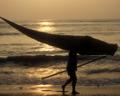
Ride in a reed boat (Huan Chaco) – About 8 miles north of Trujillo, is the beach town of Huan Chaco. Take a ride in a traditional reed boat, made of totora reeds. Kids should wear a bathing suit, or clothes that can get wet. | ||
|
Cajamarca – North and inland about 300 km (200 miles) from Trujillo, most tourists fly to Cajamarca, which sits where the Andes and the Amazon meet. With 3,000 years of human presence, the town has one of the oldest histories in the world. 550 years ago the Inca Pachacutec's brother, Capac Yupanqui, conquered the local Caxamarca peoples. Less than a hundred years later, Pizarro took then Inca Atahualpa prisoner in Cajamarca, ending one of the great civilizations on earth. | ||
| El
Carat del React – This is the only vestige of Inca architecture
left intact in the city. Imagine this room filled with gold – it once
was. From floor to ceiling, the Inca people piled gold (they filled two
nearby rooms with silver) in a vain attempt to ransom their emperor. |
|||
| Plaza
de Airman – This is where the last Inca, Atahualpa, was gruesomely
executed. Visit the Cathedral where you'll pass through the baroque portal
to find an alter covered in gold leaf – one of the last vestiges of
an empire's wealth. |
|||
|
Walks – | ||
| Cilia
Santa Apologia will reward you with a view of the entire valley. At
the top is a pre-Incan stone alter, mistakenly called "The Seat of
the Inca." (But you'll still feel pretty grand resting there.) |
|||
| Necrópolis
de Combayo is the site of pre-Incan tombs cut into living rock. Well
preserved, there are more here than any other spot in Peru. |
|||
|
Hot springs – At Banos del Inca, baths located about 5 miles from town, the water reaches 80 degree. Known across South America for its curative properties, true or not – you'll feel refreshed after a nice hot soak. |
||
|
La Colpa – Site of "El Rescate" farm, where you can see traditional ranching skills on exhibition. One of the most famous has ranch hands calling cows by name – yup! They come a-runnin'! You may want to tell your little "buckaroos" that the term is really a bad pronunciation of "vacaro" or "cowboy" in Spanish. | ||
|
Cumbemayo – Near the mountain El Cumbe, you'll find an example of the staggering Inca hydraulic system, the only spot on the continent where waters that started in the Atlantic pass on their way to the Pacific. |
|
Fun food – |
||
Cheese and corn dishes are made 101 ways here – tradition says that some recipes date back to Inca times! |
|||
|
Shopping – |
||
The area is famous for its elaborately framed mirrors and complex weavings. Pariamarca is a small peasant town famous for the patterns and colors in their textiles. Huambocancha and Porcon are famous for their artisans who work with stone. Or try Aylambo, where the University has a center that combines modern techniques with local talent. |
travel for kids | peru | northern peru |
 |
     |
|