

fun things to do with kids in tikal guatemala    
  Travel for Kids
Guatemala
  | The North
     
    Tikal (Parque Nacional de Tikal)
Tikal
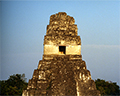
Like the Egyptian pyramids or Machu Picchu, the Maya ruins of Tikal exceed your expectations. Kids can dangling their legs on a granite block atop a temple-pyramid, the jungle stretching beyond, it's simply spectacular. Ancient Tikal was so ahead of its time – scenes for the first "Star Wars" movie were filmed at Tikal (and the rebel base of Yavin was based on the Maya architecture).
    Tikal was inhabited for a thousand years, from 900 BC to 900 AD, and at its peak, it was one of the great lowlands Maya cities. The ruins are quite extensive, over 3,000 buildings, spread over a large area in the jungle (and more structures are still buried beneath the dense rainforest). Today, Tikal is very much a local tradition. On weekends, Guatemalan families come to picnic and climb the pyramids with their children.
    At the Entrance –
Tikal
    On the walkway to the ruins, on the right is the Tikal Museum (the sign says "Ceramics Museum (Museo Ceramica)," the official name is the Museo Sylvanus G. Morley, but most importantly, this museum has an extraordinary collection of Maya goodies. To the left is the Visitors Center.
    Tip: Get a map of Tikal at the stalls outside the Visitors Center, or the Tikal handbook by William Coe also has a good map.
      At the ticket booth, kids under 12 get in free to Tikal. If you go late in the day, your ticket will be good for next day also. Around 4:00 or 5:00 pm, there are fewer people, and it's a magical time of day.
      It's about a 15 minute ½ hour walk from the entrance to the Great Plaza, depending how many times you stop to look at the huge ceiba tree (the sacred Maya "tree of life"), ants marching on the path, spider monkeys jumping from branch to branch, coatimundis rooting around for a something to eat.
Tikal
  Great Plaza Start your explorations of Tikal at the Great Plaza. To the east is Temple I, to the west Temple II. On the north side of the plaza is the dense cluster of temples, the North Acropolis. A lower group of buildings, the Central Acropolis, is on the south side. Underneath Temple I was buried one of the greatest kings of Tikal, Hasaw Chan K'awil , formerly called "Lord Chocolate."
      You can climb to the top of Temple II and there's one word for it: breathtaking. You look across the plaza to Temple I, which is even higher, and it's boggling to think that this majestic building was built with stone tools. Little kids are always climbing up Temple II, but the stairs are steep and there's nothing to hold on to. Watch your step, and take it slow, especially going down.
    North Acropolis The North Acropolis is really bunches of temples (pyramids) built one on top of the other, for hundreds of years. Underneath the temples, the kings and important people of Tikal were buried in tombs along with textiles, ceramics, precious jade ornaments and shells (you can see these things in the Tikal Museum).
Tikal
    A "must see" is the two huge masks in the North Acropolis. Originally, this soaring temple was flanked by long-nosed god sculptures, plastered and painted red and white. The temple was built over, but the (over 10 ft. high) masks have been excavated. Go to the first "thatched roof" above the plaza, and look down you'll see the first mask. Go down the steps, turn left, go through a short passage (you'll need your flashlight), turn a corner, and the second mask will be staring you in the face! Indiana Jones couldn't do it better this is the real thing.
Tikal
  Central Acropolis The Central Acropolis was the site of toyal court residential palaces and administrative centers for generations. Each ruler added his own palace and remodeled others, layering one over the other. One of the best preserved palaces is at the eastern end, the home of Jaguar Claw I. Inside, you'll just have to imagine the grand staircases, and Jaguar Claw sitting on a bench in the royal throne room, presiding over important rituals and conducting the business of state. (You can stretch out on the bench.) The Central Acropolis has a labyrinth of rooms to explore! Maybe it's just the wet jungle environment but when you're inside the rooms, they smell like tide pools at the ocean faintly organic and salty, "Tikal perfume."
Tikal
  Lost World Complex (Mundo Perdido) The Maya were incredibly good at astronomical observations, accurately charting the progress of the sun and planets. In the Lost World complex, buildings were situated precisely in relation to each other to sight the position of the sun. Most impressive is the broad Great Pyramid, almost 100 ft. high. You can climb to the top, but the steps at the top are a little crumbly. The smaller pyramids are also fun to scramble up.
    Temple IV Although Temple IV is physically the largest temple at Tikal, it's an easy climb up a wooden staircase to the top. From the top, you'll have that "Star Wars" view of Temple I and II, poking up through the dense canopy of trees.
Trails There are miles of trails through the jungle to other complexes. Some of these trails follow the causeways, raised "roads" built by the Maya through the swampy jungle. Depending on how old your kids are, or how much time you have, a nice loop is the Great Plaza to Temple IV, then take the Maudslay Causeway to Complex P, and the Mahler Causeway to the eastern end of the Great Plaza.
Birds and animals –
Tikal
    Just as interesting as the ruins is the tropical rain forest, filled with animals. Early in the morning or late in the day, the forest comes alive with "las voces de la selva," the voices of the jungle. There are hundreds of birds in Tikal parrots, hummingbirds, woodpeckers, owls, and birds (yellow-throated Euphonia) that make droopy nests in the trees in the Great Plaza.
Tikal
    Look for trails of leaf cutter ants marching in lines three by three, spider monkeys leaping gracefully from branch to branch, coatimundis (they look like a combination of anteater and raccoon plus a long swishy tail), and wild "ocellated" turkeys, sporting a powder blue head with orange bumps and iridescent feathers. We encountered some wild turkeys on the road outside the ruins, near the local eateries (comedores). The turkeys looked so well-fed, my kids called them "stomach on sticks." Local children use the turkey feathers to decorate their lovely corn husk dolls.
Site Museums –
Tikal
    Tikal Museum (Museo Sylvanus G. Morley) This small museum is filled with exquisite ceramics and artifacts excavated from Tikal. Check out the three long-nosed pale turquoise rain gods, the little figure of the "Old God" from the tomb of "First Crocodile," holding a human head in his hands, an incense burner (the Maya god is wearing an owl headdress), a platter decorated with a flapping fish, a little jade sleeping jaguar.
      Don't miss one of the best preserved stela, a portrait of the king "Stormy Sky" and a re-creation of the tomb of Hasaw Chan K'awil , formerly called "Lord Chocolate," showing how the skeleton was discovered, surrounded with jade beads, pearls, ceramics and shells.
Tikal
    Visitors Center and Stelae Museum At the Visitors Center, stelae (the huge carved stone slabs) are displayed. Outside the museum is an exhibit demonstrating how the Maya erected the heavy stelae. The flat stone was propped up with sticks, pulled upright into position, then carved in place. You can't miss the model of Tikal in front of the Visitors Center, as well as shops where you can buy guidebooks and souvenirs. If you'd like a tour guide, you can arrange for one at the Visitors Center or at your hotel.
  Tips for enjoying Tikal
Tikal
Spend more than one day There are three hotels within walking distance of the ruins. Staying overnight (or two or three nights) gives you an opportunity to explore the ruins on kids' time. You'll want to take an hour or two, just walking around the ruins in the late afternoon, when a golden glow envelopes the jungle and the animals are most active. In the heat of the day, go back to your hotel and relax, take a nap, or go for a swim in the pool.
Climate Visit the ruins early in the morning or late in the day to beat the heat. Wear light clothing and don't start to see at the ruins at 1:00 in the afternoon, you'll roast! (April to May are the hottest months.) December to February are cooler months, and a light jacket is useful in the cool mornings.
Drink lots of water When you're walking around the ruins, have plenty of bottled water.
Take flashlights and binoculars Your flashlights will come in handy to see the masks in the North Acropolis, and to run around the dark passageways in the Palacio de Las Ventanas (the Palace of the Winds, also called the "Bat Palace.") Have your binoculars to spot monkeys and birds in the trees.
What to bring Bring a picnic. There are shaded picnic tables around Tikal (try the ones west of Temple II). Wear sunscreen and hats. Although you are shaded in the trees at lot of the time, the sun is intense, and it doesn't take long to get a royal sunburn. Later in the day, insect repellent is useful (and anti-itch cream, if you do get bitten.)
   

Shopping


Near the entrance to the ruins, look for children selling adorable corn husk dolls, decorated with iridescent turkey feathers. At the shops next to the Visitors Center, buy wooden carvings of Guatemalan animals jaguars, monkeys, armadillos, crocodiles, coatimundis, as well as stone-carved replicas of artifacts from the ruins and Guatemalan textiles.

kids books tikal guatemala
     
Tikal - kids books Guatemala  
Tikal
Elizabeth Mann

Story of the kings of Tikal , especially Hasaw Chan K'awil, who constructed the pyramids in the Great Plaza. A stunning two page foldout and wonderful illustrations bring Tikal to life – you feel as if you're there, 1300 years ago. (Picture book)


Illustrated history of the ancient Maya – archeological discoveries, history of Tikal, Caracol, Copan and other city-states, lifestyles of the rulers and nobles, slaves and farmers, Maya gods and ceremonies, hieroglyphs, art and architecture. Rich, detailed historical illustrations. Good for older kids. (Chapter book)


The Ancient Maya
     
The Maya - kids books Guatemala  
The Maya
Stefanie Takacs

Get to know the Maya, from the great civilization to European conquest and the Maya today, plus fun facts about the ancient Maya – flat foreheads and large noses were beautiful, cacao beans were used as money, jade was highly prized. (Picture book)


Secrets in Stone: All About Maya Hieroglyphs
Laurie Coulter, Sarah Jane English

Fascinating, well-written story of Maya books and calendars, and breaking the code of Maya hieroglyphs – colors, animals, people and places, fancy title glyphs. Make your own messages with the "glyphmaster." (Chapter book, illustrations)


Secrets in Stone: all About Maya Hieroglyphs
     
The Hummingbird King  
The Hummingbird King
Argentina Palacios, Felipe Davalos

A magic hummingbird endows the chief's baby, Kukul, with a magic red feather. Kukul's scheming uncle steals the charm, and after Kukul becomes the new chief, the uncle jealously kills him. Kukul is transformed into a dazzling bird with iridescent green feathers and and a red chest – the quetzal bird. (Picture book)


(More children's books on other Guatemala pages)