|
|
|
|
|
|
 |
Firehouse No. 1 Museum – The Firehouse No. 1, built in 1861,
was a functioning firehouse for almost 100 years. Today the museum houses
artifacts from the Donner Parts (the groups that didn't quite make it
through the mountain passes one winter), a Maidu Indian display, and a
Joss House made in China in the 1870's, antique guns and a narrow gauge
trail model.
|
|
|
|
|
| |
|
|
Pioneer Park – Looking for a place to relax? Laze by the
public swimming pool or playgrounds, and there are grassy areas for picnics and picnic tables. |
|
|
|
|
|
|
|
Carriage Rides – Pick up a horse and carriage
in front of the National Hotel. The Nevada City Carriage Company will take
you on a carriage ride around town. You can also tour the Carriage House
and Stable (431 Uren St.) to see a beautiful old carriage house where the
horses live (a must for any horse lovers in your family). Tours are 10:00am
daily (except Tues. and Sun.). |
|
|
|
|
|
|
|
Malakoff Diggins State Historic Park (North Bloomfield
Rd.) – Take a side trip to see the Malakoff Diggins, the largest hydraulic
mining operation in the 19th century. Gold was found in Nevada City in 1851,
but the surface gold was soon depleted. One disappointed gold miner called
the diggins "Humbug." |
|
|
|
|
|
|
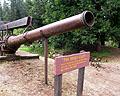
In the 1860's, hydraulic mining was used to extract the gold
from the deep gravel, buried in the hillsides. Water, stored in reservoirs,
was carried in pipes and blasted out in huge water cannons, called "monitors."
The sand and gravel were captured in sluices, where the heavier gold dropped
down and was retrieved. |
|
|
|
| |
|
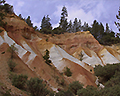
Today the Malakoff Diggins is 3,000 acres of impressive cliffs,
pine forests, mazanita groves, streams, lakes and the abandoned town of
North Bloomfield. |
|
|
|
|
|
|
 North
Bloomfield – In 1876, North Bloomfield was a thriving town with
hotels, stores, saloons, a school, and the stagecoach stopped there daily.
Once the hydraulic mining ceased, the town was abandoned. North
Bloomfield – In 1876, North Bloomfield was a thriving town with
hotels, stores, saloons, a school, and the stagecoach stopped there daily.
Once the hydraulic mining ceased, the town was abandoned. |
|
|
|
|
|
|
|
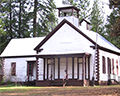
On the road into the Park, first stop to see the large school
house, church and cemetery. The school was built in 1873 "at an expense
of $3,700 which is well-furnished and has an excellent library," and
was used until 1941. The school isn't open, but you can peek inside the
windows, where you'll see old-fashioned school desks in neat rows. |
|
|
|
|
|
|
|
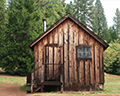
In the main part of town, you can look into the General Store and Post
Office, Kings Saloon, Smith and Knotwell Drugstore, Kallengerger Barbershop,
the livery stable and a rustic miner's cabin. You can see some of the
actual water cannons used in the mining operation, with names such as
"Little Giant," or "Hendy Giant." There are picnic
tables under the trees, so bring your lunch. |
|
|
|
|
| |
|
|
The Museum in the center of town has an informative
20 min. video about hydraulic gold mining, as well as exhibits of household
items and mining equipment, and a working model of hydraulic mining that
squirts water. Ask at the museum for gold pans to pan for gold in
Humbug Creek. |
|
|
|
|
|
|
|
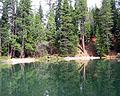
Blair
Lake – Blair Lake is only 100 yards off the main road, or take
a short trail from the campground to the lake. Bring your swim suits and
take a cool dip on a hot day. There's no lifeguard on duty and the bank
into the lake is a little steep – you may want to take your toddlers
to play in the little side creeks. |
|
|
|
|
| |
|
|
Hikes – There is wonderful wonderful hiking throughout the park. Stop at
the Museum to get an excellent map of the hiking trails. |
|
|
|
|
| |
|
|
For a short hike and to get closer to rock formations, take
the Hiller Tunnel Trail. Along the trail, the creek flows through
a hand-carved rock tunnel. |
|
|
|
|
|
|
|
The Diggins Trail takes you along the base of the cliffs,
where you get an excellent view of layers of rock, exposed by the hydraulic
mining. This loop trail is nearly 3 miles, and the trail can be overrun
with little tiny streams in the spring and early summer, so bring shoes
that can get muddy. |
|
|
|
|
| |
|
|
For good views of cliffs, stop at the West Point Overlook,
the Diggins Overlook, or the Rim Overlook in the campground. |